Written by: Cleanteethcare Clinical Review Desk (Pharmacy & Therapeutics Research Team)
Fact-Checked & Reviewed by: Cleanteethcare Medical Editorial Review Board (Clinical Pharmacy & Pharmacology Panel)
Standards: Clinically Reviewed | Evidence-Based Analysis | Directly referenced to FDA Approved Prescribing Information & Primary Peer-Reviewed Clinical Trials
Guidelines: Follows FDA Center for Drug Evaluation and Research guidance and clinical practice guidelines.
Clinical Pharmacotherapy Standard: Missed-dose thresholds and titration parameters directly cross-reference official FDA Prescribing Information labels and clinical pharmacology practice considerations.
GLP-1 dry mouth relief requires more than sipping water. Patients on semaglutide (Wegovy) or tirzepatide (Zepbound) face a compounding oral pathology: central hypothalamic hypodipsia suppresses thirst while salivary acinar cell output drops concurrently, stripping the protective pellicle from enamel and creating conditions for rapid demineralization below pH 5.5. This protocol addresses that mechanism directly.
Why GLP-1 Agents Disrupt Salivary Physiology
GLP-1 receptors are expressed in hypothalamic nuclei that regulate both appetite and fluid homeostasis. When a GLP-1 receptor agonist occupies those receptors continuously, the same central suppression that reduces caloric intake also attenuates osmotic thirst signaling. Patients do not feel dehydrated even when salivary acinar cell output has fallen measurably. The result is xerostomia without the subjective warning that normally drives fluid-seeking behavior.
Acinar cell hypofunction is the structural bottleneck. Serous acinar cells produce the aqueous, enzyme-rich fraction of saliva; mucous acinar cells produce mucin, the glycoprotein backbone of the salivary pellicle. When GLP-1 receptor activation reduces parasympathetic tone to the parotid and submandibular glands, both fractions decline. Mucin concentration drops faster than water volume, because mucin synthesis is metabolically expensive and among the first secretory outputs attenuated under autonomic downregulation.
The salivary pellicle is not decorative. It coats enamel within minutes of tooth eruption and acts as a selective diffusion barrier, slowing acid penetration and providing a substrate for remineralization. Without adequate mucin, enamel sits exposed to whatever pH the oral environment generates. Gastric reflux, a documented adverse effect of GLP-1 agents listed in the FDA Wegovy prescribing information, delivers hydrochloric acid directly to that unprotected enamel surface. Demineralization at pH below 5.5 is not theoretical at that point; it is predictable.
Clinical Transition Note: Initial starting floor doses reflect FDA de novo initiation requirements. They do not constitute an arithmetic cross-agent titration conversion protocol.
The Plain-Water Paradox: What Worsens GLP-1 Dry Mouth Relief
This is where standard lay advice diverges sharply from clinical pharmacology. Drinking large volumes of plain water does not restore salivary pellicle function. Water dilutes the residual mucin still present in oral fluid, lowers the concentration of calcium and phosphate ions that buffer enamel, and accelerates the mechanical washout of whatever protective glycoprotein layer remains. Patients who aggressively hydrate with plain water in response to xerostomia are inadvertently accelerating GLP-1 enamel erosion, not preventing it.
The mechanism matters here. Mucin is not water-soluble in the way that small electrolytes are; it forms a viscoelastic gel that adheres to hydroxyapatite through electrostatic interactions. Diluting the oral environment reduces ionic strength, which weakens those electrostatic bonds and destabilizes pellicle adhesion. Plain water, consumed in large boluses, physically disrupts that architecture.
Effective GLP-1 dry mouth relief targets mucin reconstruction, not volume replacement. Xylitol is a validated sialagogue: it stimulates parotid and submandibular secretion through gustatory-salivary reflex activation without providing fermentable substrate to Streptococcus mutans. Xylitol-containing lozenges or gum, used four to five times daily, measurably increase salivary flow rate in populations with medication-induced xerostomia. Electrolyte-buffered oral rinses containing calcium, phosphate, and fluoride ions replenish the ionic environment that mucin requires to remain adherent. These rinses do not wash pellicle away; they reinforce it.
Small, frequent sips of water between meals remain appropriate for mucosal comfort, but the therapeutic intervention for semaglutide xerostomia treatment is biochemical, not volumetric.
Immediate Clinical Protocol for Severe Xerostomia
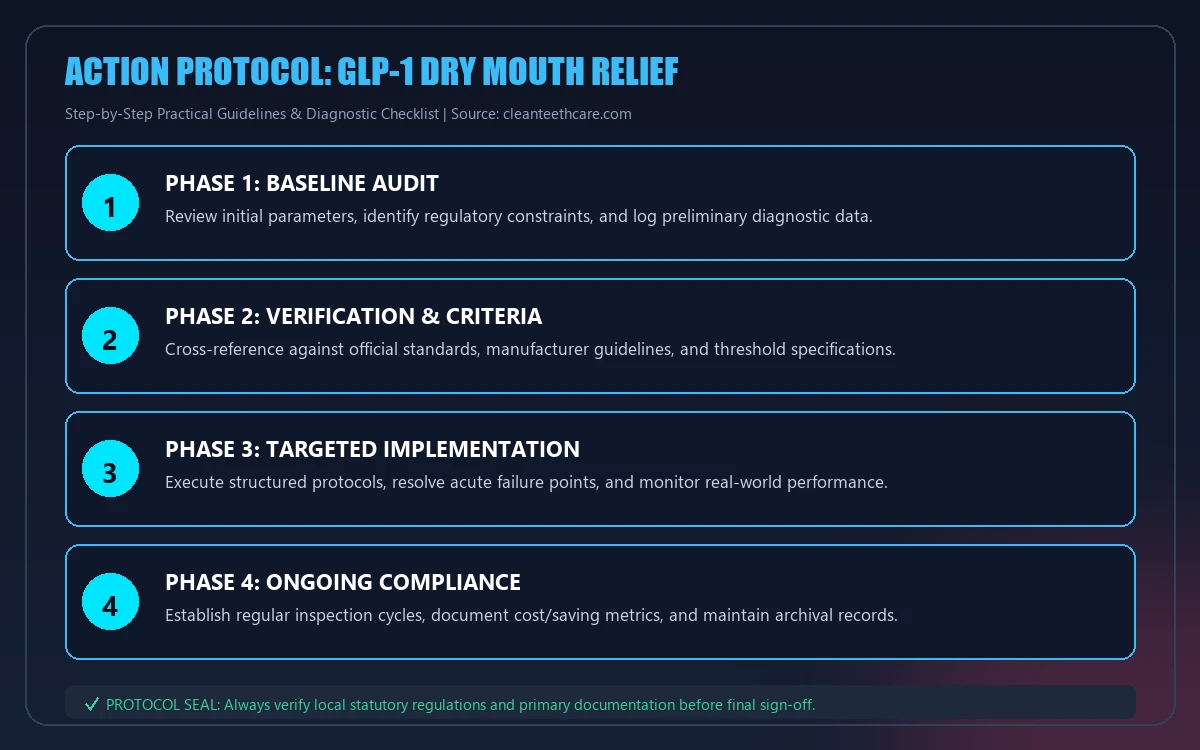
Step 1: Assess Severity and Acinar Function
Severe GLP-1 dry mouth relief management begins with distinguishing subjective dryness from objective acinar cell hypofunction. Unstimulated whole salivary flow below 0.1 mL/minute meets the clinical threshold for severe xerostomia. Stimulated flow below 0.5 mL/minute warrants active pharmacologic intervention rather than supportive care alone. A dental clinician can perform both measurements chairside within ten minutes using pre-weighed cotton rolls or calibrated collection tubes.
Concurrent oral examination should document mucosal erythema, tongue fissuring, and any evidence of GLP-1 enamel erosion at cervical margins or occlusal surfaces. Erosive lesions at palatal surfaces of maxillary anterior teeth suggest acid reflux contribution, consistent with GLP-1-related delayed gastric emptying.
Step 2: Initiate Sialagogue Therapy Immediately
Xylitol-based sialagogues represent first-line GLP-1 dry mouth relief. Dosing frequency matters more than single-dose quantity: four to five exposures per day sustains reflex stimulation across waking hours. Patients already using sorbitol-sweetened products should switch; sorbitol is fermentable and counterproductive in a demineralized oral environment.
Prescription-strength pilocarpine (5 mg three times daily, titrated to 10 mg three times daily) or cevimeline (30 mg three times daily) provides direct muscarinic M3 receptor stimulation of acinar cells when OTC sialagogues prove insufficient. Both agents require prescriber involvement and are contraindicated in uncontrolled asthma, narrow-angle glaucoma, and acute iritis. Prescribers managing patients on GLP-1 receptor agonists should be aware that pilocarpine’s cholinergic stimulation can transiently increase GI motility, which may compound nausea in patients already experiencing GLP-1-related gastroparesis symptoms.
Step 3: Rebuild the Salivary Pellicle
Electrolyte-buffered artificial saliva products (those containing carboxymethylcellulose or mucin from animal sources) applied after sialagogue stimulation provide a physical scaffold while endogenous mucin production recovers. Application before sleep is clinically significant: nocturnal salivary flow is minimal even in healthy individuals, and patients with GLP-1-induced acinar cell hypofunction face hours of unprotected enamel exposure overnight.
Fluoride varnish application (22,600 ppm sodium fluoride) at professional intervals of three to four months provides remineralization substrate when salivary calcium and phosphate delivery is compromised. High-concentration fluoride toothpaste (5,000 ppm, prescription-strength) used nightly replaces the remineralization function that saliva cannot currently perform.
Step 4: Address GLP-1 Enamel Erosion Directly
GLP-1 enamel erosion management runs parallel to xerostomia management, not sequentially. Acid from gastric reflux and from acidic dietary sources acts on enamel that is already demineralized by pellicle loss. Patients should avoid brushing within 60 minutes of any acid exposure, including reflux episodes, because brushing softened enamel accelerates abrasive loss. Rinsing with a sodium bicarbonate solution immediately after acid exposure neutralizes residual oral pH without the pellicle-stripping effect of plain water.
Dietary counseling specific to GLP-1 dry mouth relief should emphasize that carbonated beverages, citrus, and vinegar-based foods generate oral pH below 4.0, well beneath the 5.5 demineralization threshold. These sources are additive to reflux-derived acid load.
Safety Considerations, Contraindications & Clinical Supervision
This section requires careful reading before initiating any pharmacologic intervention described above.
Patients on GLP-1 receptor agonists frequently carry comorbidities that alter the risk profile of both the underlying medication and any adjunctive oral therapy.
Hypoglycemia risk rises when GLP-1 agents are combined with sulfonylureas or insulin. Xerostomia itself does not alter glycemic control, but pilocarpine-induced diaphoresis can mimic hypoglycemic symptoms and cause diagnostic confusion. Clinicians should document baseline glycemic status and advise patients to monitor blood glucose if pilocarpine is initiated.
Pancreatitis is a labeled warning in both the FDA Wegovy prescribing information and the FDA Zepbound prescribing information. Abdominal pain in a patient on a GLP-1 agent is not attributable to dry mouth or oral pathology until pancreatitis has been excluded. Oral symptoms do not substitute for abdominal clinical assessment.
Gallbladder disease, including cholelithiasis and cholecystitis, appears at increased incidence in GLP-1 trial populations. Rapid weight loss accelerates bile cholesterol saturation. This does not directly affect oral management protocols, but clinicians should not attribute right upper quadrant discomfort to GI side effects of the GLP-1 agent without appropriate workup.
Renal hydration status intersects with the xerostomia management strategy described above. Patients with chronic kidney disease stage 3 or above may have restricted fluid intake orders that conflict with any volumetric hydration recommendation. Electrolyte-buffered rinses used topically and expectorated do not contribute meaningfully to systemic fluid load and are generally appropriate even in fluid-restricted patients, but prescribers should confirm.
Oral contraceptive absorption may be altered in patients experiencing GLP-1-related vomiting or diarrhea. This is not a direct oral health interaction, but it is a clinically relevant drug interaction that prescribers managing women of reproductive age should document and address.
The FDA Zepbound prescribing information carries a boxed warning for personal or family history of medullary thyroid carcinoma (MTC) or Multiple Endocrine Neoplasia type 2 (MEN2). Tirzepatide is contraindicated in those populations. Semaglutide carries the same MTC/MEN2 contraindication per the FDA Wegovy prescribing information. Oral health providers who identify a patient on these agents should confirm that the prescribing clinician has screened for these contraindications; this is not within dental scope to manage but is within scope to flag.
Missed-Dose Protocol and Re-Titration After Oral Symptom Interruption
Some patients experiencing severe xerostomia or GLP-1 enamel erosion consider interrupting their GLP-1 therapy. Dose interruption carries significant metabolic consequences. The STEP-1 trial extension published in Diabetes, Obesity and Metabolism demonstrated that one year after withdrawal of once-weekly semaglutide 2.4 mg, participants regained approximately two-thirds of prior weight loss, with cardiometabolic improvements reverting toward baseline. The SURMOUNT-4 trial in JAMA showed that patients randomized to placebo after tirzepatide-induced weight loss regained 14.0% of body weight by week 88, while those continuing tirzepatide achieved an additional 5.5% reduction. Oral symptoms do not justify unilateral discontinuation without prescriber involvement.
Missed-dose management follows strict timing rules:
- 1 to 4 days past scheduled dose (within 96 hours): Take missed dose as soon as remembered, then shift the weekly injection schedule to that new day.
- More than 4 days past scheduled dose (beyond 96 hours): Skip the missed dose entirely. Resume on the next regular injection day. Never administer two doses within any 72-hour window.
- 14 or more days since last injection (three or more elimination half-lives elapsed): Receptor accommodation is substantially lost. Prescriber-directed conservative re-titration restart is required, beginning at the labeled starting floor — 0.25 mg weekly for semaglutide per FDA Wegovy prescribing information, or 2.5 mg weekly for tirzepatide per FDA Zepbound prescribing information , to prevent severe GI toxicity on re-exposure.
Comparative Pharmacology: Semaglutide vs. Tirzepatide Oral Risk Profile
Understanding receptor pharmacology informs why xerostomia severity may differ between agents. The SURPASS-2 head-to-head trial in NEJM compared tirzepatide at 5 mg, 10 mg, and 15 mg against semaglutide 1.0 mg weekly in type 2 diabetes, demonstrating superior HbA1c and body-weight reductions for tirzepatide at all doses. That comparison used semaglutide 1.0 mg, not the 2.4 mg obesity maintenance dose; no head-to-head trial against Wegovy-dose semaglutide exists in the published literature.
The ADA Standards of Care in Diabetes, Section 8 explicitly states that incretin mimetic agents are pharmacologically distinct entities with non-identical receptor binding profiles, and prescribers must not presume dose equivalence when switching between them.
| Parameter | Semaglutide (Wegovy) | Tirzepatide (Zepbound) |
|---|---|---|
| Active Molecule | GLP-1 receptor agonist | Dual GIP/GLP-1 receptor agonist |
| Receptor Affinity | Selective GLP-1 | GIP + GLP-1 |
| Mean Elimination Half-Life | 168 hours (7 days) | 120 hours (5 days) |
| Labeled Starting Floor | 0.25 mg weekly × 4 weeks | 2.5 mg weekly × 4 weeks |
| Titration Interval | Every 4 weeks | Every 4 weeks |
| Boxed Warning | MTC / MEN2 | MTC / MEN2 |
Tirzepatide’s shorter half-life (120 hours versus 168 hours) means receptor occupancy fluctuates more between doses, which may produce less sustained hypothalamic hypodipsia compared to semaglutide. Whether this translates to clinically meaningful differences in xerostomia severity has not been studied in a dedicated oral health endpoint trial. Clinicians managing severe medication dry mouth should not assume agent substitution resolves the problem without monitoring.
Frequently Asked Questions
What is the most effective approach to GLP-1 dry mouth relief when symptoms are severe?
Severe GLP-1 dry mouth relief requires a three-track approach running simultaneously: stimulate residual acinar cell output with xylitol sialagogues or prescription muscarinic agonists, rebuild the salivary pellicle with electrolyte-buffered artificial saliva applied at night, and protect enamel with high-concentration fluoride. Plain water consumed in large volumes worsens the condition by diluting mucin and stripping pellicle adhesion. Severity assessment using unstimulated salivary flow measurement (threshold: below 0.1 mL/minute) determines whether OTC sialagogues suffice or whether pilocarpine or cevimeline is warranted.
Can semaglutide xerostomia treatment be managed without interrupting weight-loss therapy?
Yes, in most cases. Oral symptom management and GLP-1 pharmacotherapy operate on separate clinical tracks. Interrupting semaglutide carries documented metabolic costs: the STEP-1 extension data show two-thirds of lost weight returns within one year of withdrawal. Prescribers and dental clinicians should coordinate care rather than defaulting to drug discontinuation. If xerostomia is severe enough to impair swallowing or nutrition, prescriber involvement to assess dose timing or temporary dose hold is appropriate, but unilateral patient-initiated discontinuation is not advisable.
How does acinar cell hypofunction from GLP-1 agents differ from other causes of dry mouth?
Most drug-induced xerostomia involves direct anticholinergic blockade of muscarinic M3 receptors on acinar cells — antihistamines, tricyclic antidepressants, and opioids work this way. GLP-1-induced acinar cell hypofunction is centrally mediated: hypothalamic GLP-1 receptor activation reduces parasympathetic outflow to salivary glands indirectly, while simultaneously suppressing thirst through hypodipsia. The patient therefore lacks both the salivary output and the subjective drive to compensate. This dual suppression makes GLP-1 xerostomia clinically distinct and explains why standard anticholinergic-reversal reasoning does not apply; the target is parasympathetic restoration, not receptor blockade reversal.
Does GLP-1 enamel erosion stabilize once xerostomia improves?
Enamel erosion stabilizes when two conditions are met: oral pH is consistently maintained above 5.5, and salivary pellicle coverage is restored. Xerostomia improvement is necessary but not sufficient on its own, because gastric reflux — a separate GLP-1 adverse effect from delayed emptying , continues to deliver acid to enamel surfaces regardless of salivary flow recovery. Patients need concurrent acid reflux management, dietary acid reduction, and professional fluoride application at three-to-four-month intervals until both salivary flow and reflux symptoms are controlled. Erosive lesions already present do not remineralize; they require restorative intervention if structurally significant.
References
-
Aronne LJ, et al. Continued Treatment With Tirzepatide for Maintenance of Weight Reduction in Adults With Obesity (SURMOUNT-4). JAMA. 2024;331(1):38-48. https://pubmed.ncbi.nlm.nih.gov/38078870/. Patients continuing tirzepatide maintained or increased weight reduction (additional 5.5%); placebo-randomized patients regained 14.0% body weight by week 88.
-
Wilding JPH, et al. Weight regain and cardiometabolic effects after withdrawal of semaglutide: The STEP 1 trial extension. Diabetes Obes Metab. 2022;24(8):1553-1564. https://pubmed.ncbi.nlm.nih.gov/35441470/. Two-thirds of prior weight loss regained one year after semaglutide 2.4 mg withdrawal; cardiometabolic improvements reverted toward baseline.
-
Frías JP, et al. Tirzepatide versus Semaglutide Once Weekly in Patients with Type 2 Diabetes (SURPASS-2). N Engl J Med. 2021;385(6):503-515. https://pubmed.ncbi.nlm.nih.gov/34170647/. Tirzepatide at 5 mg, 10 mg, and 15 mg achieved superior HbA1c and body-weight reductions versus semaglutide 1.0 mg weekly in type 2 diabetes. Comparison was against 1.0 mg dose, not 2.4 mg obesity maintenance dose.
-
FDA Center for Drug Evaluation and Research. Wegovy (semaglutide injection) Full Prescribing Information. 2023. https://www.accessdata.fda.gov/drugsatfda_docs/label/2023/215256s007lbl.pdf. Selective GLP-1 receptor agonist; mean elimination half-life 168 hours; mandatory initiation at 0.25 mg weekly for 4 weeks; MTC/MEN2 contraindication.
-
FDA Center for Drug Evaluation and Research. Zepbound (tirzepatide injection) Full Prescribing Information. 2023. https://www.accessdata.fda.gov/drugsatfda_docs/label/2023/217806s000lbl.pdf. Dual GIP and GLP-1 receptor agonist; mean elimination half-life 120 hours; mandatory starting dose 2.5 mg weekly for 4 weeks; boxed warning for MTC/MEN2.
-
American Diabetes Association. Standards of Care in Diabetes: Obesity and Weight Management. Diabetes Care. 2024;47(Suppl 1):S158-S178. https://diabetesjournals.org/care/article/47/Supplement_1/S158/153954/8-Obesity-and-Weight-Management-for-the. Incretin mimetic agents are pharmacologically distinct; prescribers must not presume dose equivalence across agents.